Twilight: An Unintentional Comedic Film
- kevya sims
- Dec 6, 2025
- 6 min read

In 2008, Catherine Hardwicke directed the film adaptation of Stephanie Meyer’s Twilight. I actually saw the movie before reading the book, and since the film came out when I was only ten, I genuinely thought it was peak romance—Team Jacob all the way. Looking back now, I still believe the movie follows the book’s storyline fairly closely without straying too far. However, there are definitely some major details—and a few minor ones—that aren’t fully accurate to Meyer’s original telling. And whether it was intentional or not, Twilight is accidentally funny in several moments. Still, as a film—from the cinematography to the blue-tinted color grading and the unforgettable soundtrack—Twilight remains highly memorable and continues to captivate audiences despite its flaws.

I believe the film follows the novel closely in structure. The major plot points are all in place: Bella moves to Forks, meets Edward, falls in love, meets the vampire family, joins the baseball game, becomes hunted by James, is found by the tracker, and is ultimately saved by Edward. The book itself, as I said before, is very flat and lacks depth, so seeing it transfer from page to screen so closely makes sense. This two-dimensional story wasn’t a particularly hard movie to adapt, I would think. However, there are still major and minor plot points that were changed, added, or removed from the film. I’m aware that details are always cut when transferring from print to film—and honestly, none of the changes I noticed made or broke the movie. I just noticed them.
Firstly, Jacob was introduced much earlier in the film, whereas in the book Jacob is used almost exclusively as a messenger. In the text, Jacob doesn’t appear until nearly halfway through the novel at the meetup on La Push beach, where he shares the legends about the werewolves and vampires. Hardwicke instead introduces Jacob immediately when Bella’s dad, Charlie, gifts her the truck he bought from Billy Black. I believe the screenwriters made the right choice here because it adds an awkward, budding romantic tension that becomes important in later films. This early setup is reinforced by Jacob’s appearance at the end of the movie, where he says his dad told him to warn Bella to break up with her boyfriend. There’s light banter and chemistry between them, and when Edward approaches, the tension instantly creates the foundation for a perfect cinematic love triangle. A minor change from book to film is that Jacob dances with Bella at prom in the book, but in the movie Edward blocks him. I also want to say that the quirky, insider jokes the characters share sometimes are hilarious—like when Edward says, “I leave you alone for two minutes and the wolves descend.”

Another major change centers on the antagonists James, Victoria, and Laurent. In the film, the trio is shown briefly on a hunt, and then later killing Waylon Forge—Charlie’s friend—before the baseball scene, whereas in the book they aren’t introduced until the baseball game itself. These additions heighten the drama and enhance the cinematic experience. They make the antagonists feel more personal and threatening, especially because Charlie loses a friend to them and is actively investigating the killings. His early theory is that the deaths were caused by animal attacks, but he abandons this notion after pursuing Victoria and finding a human footprint. Hardwicke did a great job adding this storyline; if the trio weren’t introduced until the baseball scene—halfway through the movie—the tension wouldn’t have had time to build, nor would the danger have felt as personal.
There are also a few character-profile changes that I believe enrich the film. For instance, the regular father-daughter dinners at the diner add warmth and provide a sense of bonding that the book portrays differently. In the novel, Bella and Charlie do share moments at home—especially through Bella cooking for him—but the movie’s diner scenes create a stronger sense of community, reinforced when Waylon dies and the staff asks Charlie for updates. Bella is also more communicative and open with her mother in the film than in the book. On-screen, she speaks freely about her life and even about boys, whereas in the book she mostly keeps in touch via short emails. These shifts in her parental relationships help ground Bella more as a character; even though she becomes obsessed with Edward, these moments make her more relatable. I also noticed that Charlie is depicted as more protective in the film than in the book, where he mainly fills the role of quiet caretaker. The scene where he places the shotgun on the table before Bella’s date, and the moment he gives her pepper spray, add awkward dad humor and give him greater depth.

Edward also displays some profile shifts. In the film, he’s more open about vampirism earlier than book-Edward ever was. In the novel, Edward becomes angry when Alice explains to Bella how to become a vampire; in contrast, film-Edward’s openness comes across as slightly predatory, because this information didn’t need to be shared if his true intention was for Bella to never become like him. A minor change I noticed is how Bella seems to enjoy running with Edward in the film, whereas in the book she is terrified and nearly becomes sick. This small change results in a major shift in tone and contributes to one of my favorite scenes: the treetop moment. When Edward takes Bella into the trees, the film slows down, giving one of its most iconic moments—the two of them perched high above the forest, the camera sweeping around them while a soft piano score plays. The scene is dreamy and almost unreal, bathing their relationship in a heightened, fairytale atmosphere. It’s the first time the film leans fully into fantasy romance, using landscape and music to show that Bella is stepping into a world that’s both beautiful and dangerous.
When reading the novel, I never realized how much comedy lived between the lines. Although the storyline and depth improved in the film, the acting often hindered my ability to fully engage with the emotional moments. I want to acknowledge that Kristen Stewart played the awkward, insecure, detached trope well, and Robert Pattinson embodied the obsessive, predatory attraction exactly as written. But Stewart’s emotional scenes were hard to watch at times, and Bella’s extreme obsession feels more intense on screen. Specifically, in the hospital scene after James attacks her, Bella’s anxious emotional attachment is overwhelming; if Edward even mentions leaving, she genuinely starts tweaking. Also, Twilight was unintentionally funny, and I found myself laughing at many of the awkward moments. I assume Robert Pattinson and Hardwicke intended for Edward to be brooding and pained, but the creepy stares and long pauses often came across as odd. Many of his strained expressions were hysterical—he often looked like he needed a bowel movement. While the film isn’t a comedy, it has a dry humor woven beneath the surface.
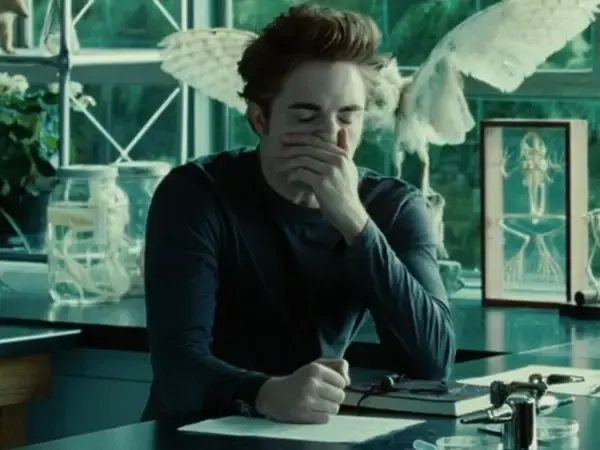
Still, even though I laughed during moments meant to feel moving or awe-inspiring, certain aspects of the film did captivate me. If the soundtrack played today, I would instantly know which scene it belonged to. The soft, emotional piano during Bella and Edward’s iconic moment—part of Carter Burwell’s score—is unforgettable. The color grading and blue-tinted filter set the moody tone and represent the book’s atmosphere well: morose, gloomy, intense. The set design perfectly fits the story’s vibe, from Charlie and Bella’s modest home, to the Cullens’ modern glass house tucked into the forest, to the baseball field where the epic showdown begins. If I had read the book before watching the film, I would have imagined the settings exactly as they appear on screen. The graduation-cap wall was a clever and humorous addition that gave the Cullen family more personality. The baseball scene was executed perfectly, creating the right amount of tension and buildup before the confrontation. I also enjoyed the post-attack montage and felt it added strong imagery and cinematography.
Overall, I believe Hardwicke created a successful adaptation that closely follows Stephanie Meyer’s original telling of Twilight. The added details in the script serve their purpose—they deepen character dynamics, heighten the central conflict, and subtly lay the groundwork for the love triangle that becomes so crucial later in the series. Visually and tonally, the film leans into its moody, blue-tinted style, creating a distinct cinematic identity that audiences still recognize instantly. And while some moments come off unintentionally funny—like Edward’s constipated glares—that charm is part of what makes Twilight such a lasting cultural staple and viral meme generator. As an adaptation, it may not be perfect, but it captures the essence of the book and translates it into a cinematic experience that continues to resonate with fans years later.

Comments